

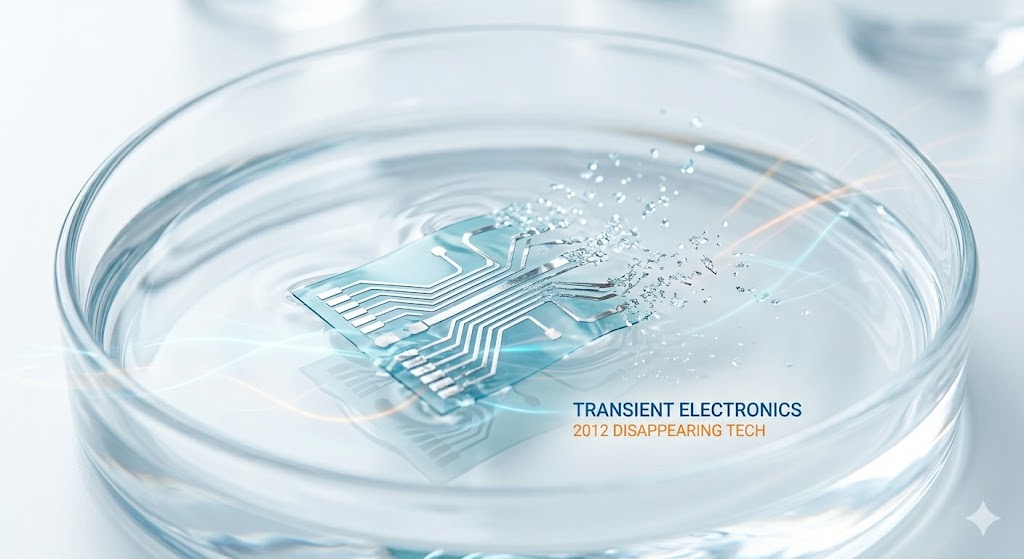
Transient Electronics: Devices That Dissolve After Use
September 28, 2012
The Rise of Disappearing Technology
Undoubtedly, the world of hardware is entering a surreal new chapter this autumn. As a matter of fact, researchers have just unveiled a class of transient electronics that can physically vanish on command. First and foremost, we have spent decades engineering gadgets to last forever. However, a multidisciplinary team led by John Rogers at the University of Illinois has flipped this philosophy upside down. Today, we are looking at circuits that function perfectly for a set time and then completely dissolve in water. Therefore, we are exploring how this “disappearing act” will revolutionize medicine, environmental monitoring, and consumer waste.
How Transient Electronics 2012 Actually Work
To begin with, the science behind these devices is as elegant as it is complex. In fact, the team uses incredibly thin sheets of silicon, known as nanomembranes, which are only a few nanometers thick. Because these layers are so minuscule, they can dissolve in water or body fluids within days or weeks. Initially, the researchers protect the internal components using a “fuse” made of silk. By adjusting the crystalline structure of the silk, they can program the device to last for minutes or even years. Consequently, this level of precision timing is a concept we deeply admire in our Custom Website Design—building systems that perform exactly when needed.
Key Materials and Components
Specifically, the team avoided exotic, toxic chemicals to ensure the devices remain biocompatible. Notably, they used:
- Magnesium: For the electrodes and conductors.
- Magnesium Oxide: To act as a dielectric layer.
- Silk: To serve as the protective packaging and timing mechanism.As a result, when the device dissolves, it leaves behind only trace amounts of minerals that are already naturally present in the human body or the environment.
Groundbreaking Applications for a Disappearing Future
Interestingly, the potential uses for transient electronics are nearly limitless. Instead of permanent hardware, we are looking at “temporary” solutions for high-stakes problems. When we manage Search Engine Optimization for our Kelowna clients, we focus on long-term authority; however, in the world of sensors, sometimes “short-term” is the ultimate goal.
- Medical Implants: Imagine a post-surgery monitor that tracks infection or brain activity and then safely resorbs into the body. This eliminates the need for a second, risky surgery to remove the device.
- Environmental Sensors: Scientists could lace an oil spill or a sensitive ecosystem with sensors that gather data and then wash away with the rain.
- Consumer Waste: The transient electronics research suggests a future where your old cell phone’s internal circuitry could dissolve, dramatically reducing the global e-waste crisis.
| Application | Primary Benefit | 2012 Status |
| Medical | No secondary surgery required | Tested successfully in mice |
| Environmental | Zero-impact monitoring | Prototype sensors functional |
| Military | “Self-destructing” data security | DARPA-funded research |
| Consumer | Massive e-waste reduction | Theoretical concept |
Frequently Asked Questions (Q&A)
Undoubtedly, this research has high-level support. In fact, the work was partially funded by DARPA (the Defense Advanced Research Projects Agency). Because the military is interested in sensors that can disappear after a mission, they have provided significant resources to push this technology forward.
Generally speaking, no. While the transient electronics breakthrough is exciting, your current devices are still built with thick, durable silicon and plastic. Therefore, you still need to be careful with your gadgets. However, this research proves that we can now build high-performance electronics that are deliberately “fragile” when exposed to the right triggers.
Absolutely. Specifically, the materials used—silicon, magnesium, and silk—are all biocompatible in the small quantities used. According to the team’s findings, the body absorbs these components without any signs of inflammation or toxicity. Ultimately, this is much like our PPC Management philosophy: we only use strategies that are healthy for your brand’s long-term growth.
Embracing the Temporary
In conclusion, the transient electronics milestone marks the beginning of a “disposable” era that is actually good for the planet. As we look ahead, the ability to create high-tech devices that vanish after their work is done will change everything from healthcare to recycling. At KWD Marketing, we love seeing innovations that solve massive problems with elegant, data-driven solutions. If you are ready to make your business presence “permanent” in the digital world while staying on the cutting edge, we are here to help. Contact us today to discuss a high-performance strategy for your brand.
Tags: biodegradable electronics, bioresorbable sensors, DARPA, eco-friendly tech, John Rogers, KWD Marketing, medical implants, transient electronics 2012Categorized in: Electronics